
Iron-Clad? Why a Premarital Agreement in Texas is Often Three Documents
Last night, I had the opportunity to present my paper, “Drafting Iron-Clad Premarital and Postmarital Agreements in Texas“, to the Annette Stewart American Inn of Court in Dallas. In preparing the paper and presentation, I kept coming back to a basic question: What actually makes a marital agreement “iron-clad”?
My answer is not simply more provisions or more pages.
An iron-clad agreement should accomplish two things:
First, it should survive the enforceability challenge.
Second, once enforced, it should apply itself.
That means no unnecessary fact issues over execution, but it also means no dueling experts, complicated formulas, or years of litigation over what the agreement means.
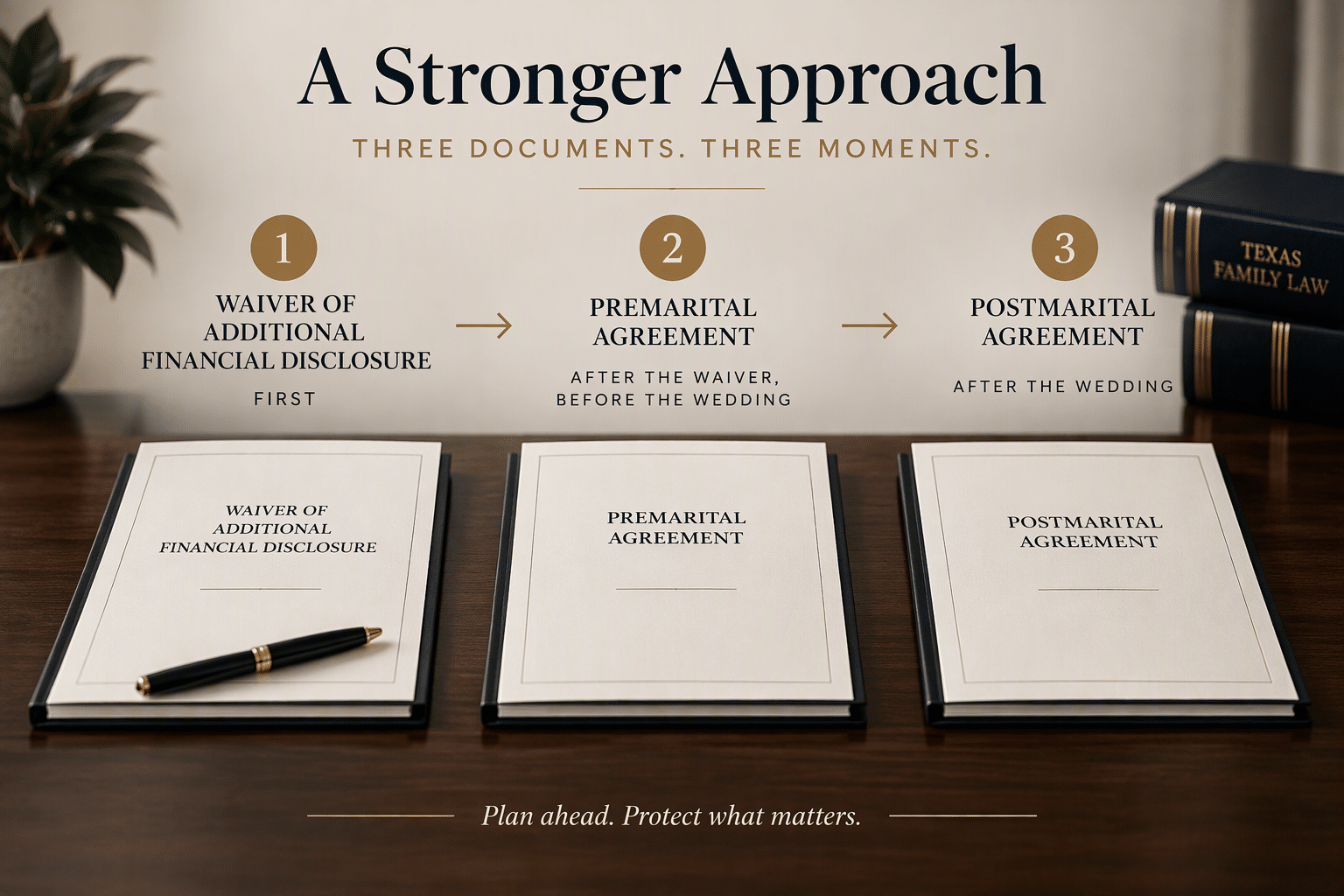
One part of my approach that may be a little different is this: I don’t think of a prenup as one document. For me, it is a three-document process.
-
The Separate Waiver of Disclosure
The first document is a separate written waiver of additional financial disclosure. The reason comes directly from Texas Family Code § 4.006(a)(2).
Texas law gives a party challenging a premarital agreement two statutory avenues: involuntary execution, or unconscionability combined with the three statutory disclosure failures. Those defenses are exclusive under § 4.006(c). The current Texas Family Code likewise identifies Chapter 4 as governing premarital and marital property agreements.
The second disclosure element asks whether, “before signing the agreement,” the challenging party voluntarily and expressly waived in writing any right to additional disclosure beyond what had already been provided.
I think the word “before” deserves more attention than it sometimes receives.
A waiver contained within the premarital agreement is executed at the same time as the agreement. So my preference is to remove the issue altogether: use a separate waiver, sign it first, and document the sequence.
And if the waiver and agreement are signed on the same day, I record the time, not simply the date:
10:05 a.m. — waiver signed.
11:30 a.m. — premarital agreement signed.
Years later, no witness has to remember which document came first. The execution record answers the question.
This is particularly important because Texas cases show that paperwork cannot substitute for process.
In Moore v. Moore, 383 S.W.3d 190 (Tex. App.—Dallas 2012, pet. denied), the final agreement was presented only four to five hours before a destination wedding, the schedules lacked values, the final draft did not show the changes that had been made, and the bride could not reach her lawyer. The Dallas Court of Appeals also made an important point about recitals: the party seeking enforcement could not prevent an involuntariness challenge simply by putting favorable recitations into the very agreement claimed to have been involuntarily signed.
(I was one of trial counsel for Mrs. Moore.)
Recitals can document a good process. They cannot manufacture one.
-
The Premarital Agreement
The second document is the premarital agreement itself.
This is where characterization, waivers, payments upon divorce, death provisions, and the other substantive terms generally reside. Texas Family Code § 4.003 permits prospective spouses to contract broadly concerning present and future property, management and control, disposition upon divorce or death, spousal support, life insurance, choice of law, and other matters not prohibited by public policy or criminal statute.
But one particular issue illustrates why I don’t stop there.
The Texas Constitution creates an interesting distinction concerning income from separate property.
The partition-and-exchange power belongs to “persons about to marry and spouses.” The power to agree that income from separate property will remain separate, however, belongs to “spouses.”
Texas appellate decisions including Dokmanovic v. Schwarz, Jurek v. Couch-Jurek, Winger v. Pianka, and In re Knott support accomplishing the result in a prenup through a properly drafted bilateral partition and exchange of the parties’ future community interests in income.
But there is enough history in the cases to make drafting important. Bradley involved language contemplating future action. Fanning rejected a provision invoking the spouses-only constitutional authority while upholding another provision under a partition theory. And the Texas Supreme Court has never squarely resolved the future-income issue on precisely the theory on which some courts of appeals have relied.
My response is simple: Do it correctly in the prenup. Then do it again after the wedding.
-
The Postmarital Agreement
That brings me to the third document: a short postmarital agreement signed after the wedding.
I use it for three principal reasons.
- First, separate-property income.
Now the parties unquestionably are “spouses.” The postmarital agreement can address the issue under both §§ 4.102 and 4.103. It is a relatively inexpensive additional layer of protection against what could someday be a very expensive characterization dispute.
- Second, ERISA.
A fiancé cannot provide the spousal consent necessary to waive certain survivor rights in a qualified retirement plan. Treasury regulations expressly provide that an agreement entered into before marriage does not satisfy those consent requirements. And cases such as Hagwood v. Newton, Hurwitz v. Sher, and MidAmerican Pension & Employee Benefits Plans Administrative Committee v. Cox illustrate the problem.
So the postmarital documents should address the necessary spousal consent and the obligation to execute whatever plan-specific forms may be required.
- Third, ratification.
This may be the most practical reason of all. Suppose a spouse later contends that the premarital agreement was signed because of pressure from an approaching wedding. The postmarital agreement creates another question: Why did that same person reaffirm the arrangement after the wedding, when the parties were already married, and the approaching ceremony was no longer part of the equation?
This approach forces a later challenger to confront instruments executed at different times and under different circumstances.
That is why I attach the contemplated postmarital agreement to the prenup itself. The parties know before the marriage exactly what they are being asked to sign afterward. There is no later drafting from memory and no surprise about the terms.
The larger lesson
None of these techniques can make an agreement voluntary if it really was involuntary. They cannot cure fraud, deception, inadequate disclosure, or a fundamentally bad execution process. Nor should they.
Stankewich is a good recent illustration of circumstances that drafting cannot cure. By contrast, Choudhury illustrates the power of a clean execution record: independent counsel, actual negotiation, a chosen signing location, initialed provisions, and notarization all became meaningful evidence when enforceability was later challenged.
That gets to what I think is the real job of the lawyer drafting these agreements:
Identify today the arguments someone may make years from now, and eliminate as many of those arguments as possible while everyone is informed, represented, and getting along.
- A good marital agreement shouldn’t merely be enforceable.
- It should be drafted with the eventual enforcement record already in mind.
And after a court says it is enforceable, the agreement should be simple and precise enough that there is little left for the court to decide.
That’s what I mean by “iron-clad.”
Contact Brad LaMorgese To Discuss Your Marital Agreement Questions
Brad M. LaMorgese is Board Certified in Family Law by the Texas Board of Legal Specialization and focuses his practice on sophisticated family law matters involving significant financial complexity. He regularly represents clients in high-net-worth divorce litigation, complex property disputes, business ownership cases, and strategic family law matters requiring long-term financial planning.
To schedule a consultation, call our Dallas marital agreement attorney at LaMorgese Family Law at 214-295-7200. Brad LaMorgese represents clients throughout Dallas and Dallas County, Texas, in complex family law matters involving substantial assets and significant financial interests.
Disclaimer: This article is provided for educational and informational purposes only. It is not legal advice and does not create an attorney-client relationship. Because every case is fact-specific, readers should consult qualified legal counsel regarding their individual circumstances.
